Skills Passport and verifiable learning credentials
Last reviewed:
SAVI Credentials provides verifiable evidence of completed learning, Open Badges and a Skills Passport for viewing supported course completions and credentials.
Verify a badge
Open a verification link that ends with /badges/verify/{assertionId}.
The passport is a record of SAVI-issued Open Badges. SAVI does not award regulated qualifications.
Evidence and sources
SAVI Credentials records learning completed on SAVI Education. Compared with a regulated qualification, a badge or Skills Passport entry is evidence of that SAVI activity. Completion is not competence, and SAVI does not award GCSEs or other regulated qualifications.
Issuer. SAVI Credentials issues Open Badges for SAVI learning.
Verification. A public verification link shows whether a badge is valid or revoked without signing in as the learner.
Validity. The record stands for the learning and date it describes unless that badge states an expiry or is revoked.
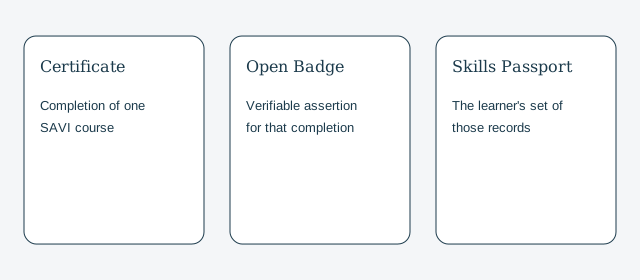
A certificate, a badge and the Skills Passport are three views of SAVI training evidence.
What a SAVI credential proves
The SAVI Skills Passport is the learner's collection of completions and badges issued for SAVI School and SAVI Workplace learning. A SAVI credential proves that the named person completed the named SAVI activity and that an employer can open the verification URL. It does not prove a regulated qualification, a licence to practise, or membership of a professional body.
Where a badge is issued, it follows the 1EdTech Open Badges specification so the assertion can be checked. A certificate is the completion document for one course. The passport is the portable set of those records. Expiry and renewal apply only when the course itself has a renewal rule; SAVI does not invent an expiry for a course that has none.
Certificate, passport, or regulated qualification
A digital certificate is for one completed SAVI course.
A Skills Passport is for a person who needs those records in one place an employer can verify.
A regulated qualification is awarded by an awarding organisation against a regulated specification. SAVI credentials are not that award.
Direct answer
SAVI Credentials turns completed learning into portable digital evidence. Learners and employers can retain training records, demonstrate achievement and support audit, compliance and workforce-development processes. The SAVI Skills Passport brings supported learning records and credentials together so training evidence can be viewed and, where authorised, verified. See [Workplace training and CPD](/business). See [View the SAVI Skills Passport](/passport). See [Skills Passport evidence guide](/articles/skills-passport-evidence-guide).
Evidence and sources
SAVI Credentials are linked to completed learning records within SAVI Education, and the SAVI Skills Passport brings supported learning records and credentials together in one place. A SAVI Credential records the learning achievement it represents; it does not by itself mean that a course is a statutory, regulated or exam-board qualification.
SAVI Skills Passport and digital credentials
SAVI Credentials provides digital evidence of training, skills and achievement linked to completed learning within SAVI Education.
Questions we answer
What is the SAVI Skills Passport?
The SAVI Skills Passport is a learner record for supported completed learning and digital credentials. It is designed to make training achievements easier to view and evidence rather than relying only on unverified claims.
What is an Open Badge?
An Open Badge is a digital credential format that can carry information about an achievement and its issuer. SAVI uses supported badge records to provide verifiable evidence of completed learning.
Can employers use SAVI credentials as training evidence?
SAVI credentials and learning records can provide evidence that supported SAVI learning was completed. Employers remain responsible for deciding what evidence is required for a particular role, policy or regulatory requirement.
Does a SAVI credential mean a course is a regulated qualification?
Not automatically. A SAVI credential records the learning achievement it represents. A course is only a regulated or externally recognised qualification where that status applies separately to the course.
Can credentials expire or be updated?
Credentials and training records may include validity or renewal requirements where the underlying course, assessment or compliance process requires them.
Can employers verify training?
Employers can review Skills Passport entries for people in their organisation and open public Open Badge verification links. Verification shows SAVI-issued evidence, not a regulated qualification check.
How do I verify a SAVI badge?
Open the SAVI verification link associated with the badge. Supported badge verification URLs use the SAVI badge verification route and display the issued credential record.
What does a SAVI Credential show?
A SAVI Credential records an achievement associated with completed learning or assessment. The evidence and assessment requirements depend on the relevant SAVI course or programme.
Can employers use the Skills Passport to check training?
The Skills Passport is designed to provide a clearer record of supported training achievements. Employer access and verification depend on the credential and the organisation’s SAVI configuration.